

Zircuit is an Ethereum Layer 2 (L2) that combines zero-knowledge validity proofs with Optimism’s Bedrock infrastructure, aiming to process transactions faster and cheaper than Ethereum mainnet. It also adds a security layer most rollups don’t offer — AI-powered threat detection at the sequencer level, before a malicious transaction ever reaches a block.
This guide walks through everything you need to understand Zircuit, in order:
- The basics first: What ZK-rollups are, how EVM compatibility works, and why both concepts are foundational to understanding Zircuit’s design choices.
- Zircuit’s core features: Its hybrid architecture, full EVM compatibility, Sequencer-Level Security (SLS), native bridge, and parallelized proving system.
- How it all connects: Zircuit’s actual transaction flow, from sequencer to prover to L1 verification.
- How it compares: A side-by-side look at Zircuit versus other blockchain scalability solutions.
By the end, you’ll understand not just what Zircuit is, but the specific problems it was engineered to solve.
TL;DR: What Is Zircuit?
- Zircuit is an Ethereum L2 scaling solution (specifically a hybrid ZK rollup) designed to process transactions faster and cheaper than Ethereum mainnet while inheriting Ethereum’s security.
- Zircuit’s testnet launched around November 2023, and Mainnet Phase 1 went live on August 5, 2024.
- It’s built on Optimism’s Bedrock framework, the OP Stack, combining optimistic-rollup infrastructure with zero-knowledge validity proofs.
- Zircuit supports the Ethereum Virtual Machine natively, so developers can deploy existing Solidity smart contracts and use familiar tools.
- Zircuit’s signature feature is its AI-powered detection system that screens transactions in the mempool before they’re included in a block, rather than relying solely on application-layer security.
- It offers a canonical bridge for moving assets between Ethereum and Zircuit, alongside third-party bridging options.
- Its native token, ZRC, was launched via a token generation event on November 25, 2024, with a total supply of 10 billion tokens, used for ecosystem rewards and incentives. Gas fees on Zircuit are paid in ETH, not ZRC.
- Zircuit has received research grants from the Ethereum Foundation and Zcash Foundation, and counts investors like Pantera Capital and Dragonfly Capital among its backers.
Before Zircuit: What Are EVM-Compatible Chains?
An EVM-compatible chain is a blockchain that runs the Ethereum Virtual Machine (EVM), the same runtime environment Ethereum uses to execute smart contracts.
Developers who build on an EVM-compatible chain write contracts in Solidity and use the same wallets, libraries, and developer tools you’d use on Ethereum itself, without rewriting anything for a new environment.
This matters directly for understanding Zircuit’s design choices. Early zero-knowledge rollups often broke EVM compatibility on purpose.
Generating a validity proof for arbitrary EVM bytecode was computationally expensive, so projects like early zkSync and StarkNet built custom virtual machines and languages (like Cairo) instead. That decision made proving faster, but it forced devs to learn new tooling and often rewrite Solidity contracts from scratch.
Optimistic rollups like Arbitrum and Optimism avoided this trade-off since they didn’t need proof-friendly circuits, which is part of why EVM equivalence became the developer expectation for any serious Layer 2 since Optimism popularized the team “EVM equivalence” in late 2021.
Zircuit closed this gap for ZK-rollups specifically. Built on Optimism’s Bedrock architecture (which we’ll go over shortly), Zircuit inherits full EVM equivalence from the start, so developers can:
- Deploy existing Solidity contracts unchanged
- Keep using Hardhat, Foundry, ethers.js, or Wagmi
- Connect with MetaMask and other standard Ethereum wallets
Before Zircuit: What Does “ZK-Rollup” Mean?
Zero-knowledge rollups, or ZK-rollups, are L2 scaling solutions designed to increase Ethereum’s transaction throughput by moving computation and state-storage off-chain.
They’re called “rollups” because they roll up (i.e., bundle) a set of transactions, process them off-chain, and only submit a summary representing all the batched transactions to the mainnet.
In addition to this summary, ZK-rollup nodes submit a validity proof confirming the veracity of the off-chain transactions. The validity proof is verified by a smart contract deployed on the L1 chain.
Simply put, ZK-rollups reduce the amount of data that needs to be processed and stored on the Ethereum network while maintaining security. Other benefits of this scaling solution include:
- Faster transactions with lower fees by bundling multiple transactions into a single mainnet entry
- Trustlessness since they rely on cryptographic mechanisms for security
- Efficient, verifiable correctness, since the validity proof lets Ethereum confirm a batch was executed correctly without re-running every transaction itself
- No delays when withdrawing funds, unlike with optimistic rollups
However, zero-knowledge rollups also have drawbacks, including:
- Limited compatibility with EVM, requiring developers to learn other coding languages and frameworks (though many ZK-rollups now offer EVM equivalence)
- Substantial computational costs that may result in increased fees
- Centralization concerns since validity proofs require specialized hardware that can handle their computational complexity and some networks use a single node as the sequencer
Zircuit’s research into rollup security tooling, rollup compression, and scaling cryptography, among other topics, has allowed it to overcome these downsides.
To understand how, let’s explore Zircuit’s core features and transaction flow.
Zircuit’s Core Features
The Zircuit team combined optimistic infrastructure with zero-knowledge proofs to get the best of both worlds and improve performance and security.
As mentioned, Zircuit overcomes the drawbacks associated with zero-knowledge rollups. And while it also uses optimistic infrastructure, it doesn’t require a challenge period for withdrawals. See? The best of both worlds.
Here are the key features that make it possible.
Hybrid Architecture: Zircuit Combines the OP Stack With ZK Validity Proofs
Zircuit describes its hybrid approach as a combination of zero-knowledge proofs and battle-tested infrastructure.
By “battle-tested infrastructure,” they mean Optimism’s Bedrock, the leading rollup development framework they used to build Zircuit.
This framework improved on its predecessor by optimizing batch compression, lowering fees, using Ethereum as a data availability layer, reducing deposit confirmation times from 10 to 2.5 minutes, and more.
Most importantly, Bedrock has improved proof modularity and Ethereum equivalence.
This framework allows developers to swap out different components and add new capabilities. For example, it abstracts the proof system, allowing you to choose between using a fault proof or validity proof.
Zircuit initially built its zkEVM circuits on Halo2, but has since migrated to a zkVM-based prover built on SP1, Succinct’s general-purpose zero-knowledge virtual machine, via the OP-Succinct framework.
They further modified the architecture with innovations resulting from their Ethereum Foundation and Zcash Foundation-funded L2 research — I’ll go over them in features #3, #4, and #5.
Besides Optimism’s Bedrock and its zkVM-based prover, Zircuit’s tech stack includes Geth.
Zircuit’s Full EVM Compatibility
Bedrock uses battle-tested Ethereum architecture and infrastructure as much as possible. By building on this framework, Zircuit has inherited its full EVM compatibility and security.
What does this mean for developers and users?
- Tools, dApps, and Web3 wallets work the same as you’re used to.
- To deploy an Ethereum dApp, you don’t need to learn a new programming language or framework. Just change the deployment endpoints when you’re ready to launch.
- The same goes for smart contracts; you can deploy EVM-compatible smart contract code on Zircuit.
While all fees are paid in ETH (as per Zircuit’s FAQ), the project has launched a native token, ZRC, via a November 2024 token generation event (TGE). It’s used for ecosystem rewards and incentives rather than as a requirement for using the network.
All in all, the developer experience is essentially the same, apart from some inherent differences between an L1 and a rollup, such as the block time and fee model.
Zircuit Parallelizes Proof Generation to Improve Speed and Cut Costs
Besides inheriting Ethereum’s security, Zircuit offers users additional protection in a unique way.
Typical security efforts strictly focus on the application and smart contract layers. Zircuit prevents attacks by monitoring the mempool for malicious transactions at the sequencer level — in addition to security efforts focused on the application and smart contract levels.
If malicious transactions, exploit contracts, or other issues are detected and verified, Zircuit’s AI-powered system flags and routes them into a quarantine layer rather than allowing immediate inclusion in the next block.
From there, quarantined transactions are evaluated against defined release conditions, such as:
- A replaced nonce
- A time limit
- A failed state check
- An administrative override for false positives
- Slashed collateral
Only then are they released for execution or permanently excluded. This results in a more secure chain for projects and users.
Zircuit’s Native Bridge Protects Funds During Cross-Chain Transfers
Zircuit’s secure native bridge infrastructure was built following best practices for a safe and secure architecture. This ensures transactions are safe and easy.
When you deposit, you’re moving assets from Ethereum to Zircuit, and when you withdraw, it’s the other way around.
Deposits typically confirm in under a minute, while withdrawals require proving the transaction and waiting through a finalization period (currently around 4 hours, according to L2Beat data) before funds can be claimed on Ethereum.
This is far shorter than the roughly 7-day challenge period typical of optimistic rollups. The bridge ensures your assets stay safe during this process.
Zircuit Splits Circuits to Improve Speed and Cut Costs
In traditional blockchains, transactions are processed linearly, which can lead to significant bottlenecks during high network usage times.
Zircuit has changed transaction processing with its innovative approach of parallelizing proof generation.
Originally, this meant decomposing its Halo2-based zkEVM circuits into specialized parts; since migrating to a zkVM-based prover built on SP1, Zircuit now achieves the same effect by proving multiple block ranges independently and simultaneously, then recursively combining them into a single proof submitted to Ethereum.
Instead of the traditional one-after-the-other processing, Zircuit breaks down transaction proving into simpler components and processes them in parallel. (If you come from a traditional IT background, think of it as task parallelism.)
This innovation allows Zircuit to take on a much higher volume of transactions simultaneously, reducing latency and scaling the network’s throughput.
Let’s explore how this fits into the Zircuit transaction flow.
Zircuit Transaction Flow and Provers
Once the sequencer tells the execution engine which transactions should be in a block and the execution engine processes those transactions into L2 blocks, those blocks are processed by Zircuit provers.
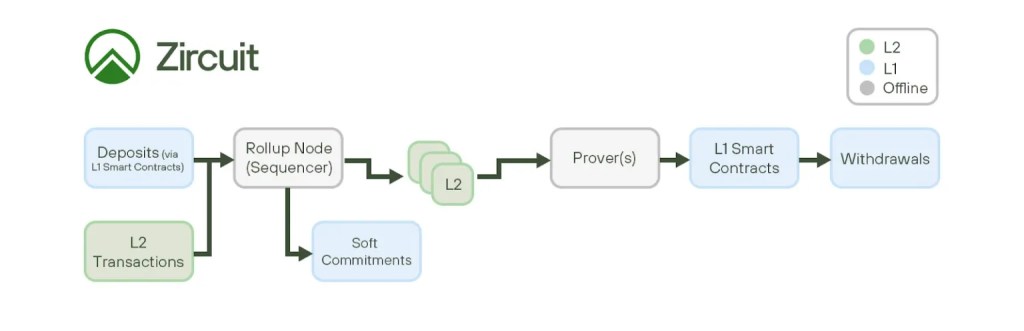
“Zircuit provers” were originally decomposed Halo2 SNARK circuits.
Since migrating to a zkVM-based proving system, Zircuit provers now consist of range provers and an aggregation prover.
According to recent research on Zircuit’s proof production infrastructure, range provers each generate a validity proof for a batch of L2 blocks (e.g., 100 blocks at a time) by running the rollup’s state transition logic inside the SP1 zkVM, rather than through separately hand-built circuits for each operation type.
This produces several smaller proofs that are faster to generate. They’re later aggregated by the aggregation prover to form a single validity proof (currently a Groth16 proof) for a batch of L2 blocks that can be verified on Ethereum with a smart contract.
The result? A zero-knowledge rollup that’s much more efficient, has lower operational costs, and allows for cheaper and faster transactions.
Conclusion: What Makes Zircuit Different From Other Scaling Solutions?
Zircuit isn’t the only Layer 2 competing for developers and liquidity, but its combination of features is distinct. For example:
- Arbitrum sticks to optimistic security, which is fast and familiar, but requires a 7-day withdrawal wait.
- zkSync Era leans fully into ZK-native execution.
Meanwhile, Zircuit blends Optimism’s Bedrock infrastructure with zkVM-based validity proofs and adds a security layer neither competitor offers — Sequencer-Level Security, which screens and quarantines malicious transactions before they reach a block.
Here’s a quick-glance overview of Zircuit vs. similar scaling solutions:
| Feature | Zircuit | Arbitrum | zkSync Era |
| Rollup type | Hybrid (Optimistic infra + ZK proofs) | Optimistic | ZK-native |
| EVM compatibility | Full | Full | Full |
| Typical withdrawal time | ~4 hours | ~7 days | ~3–24 hours |
| Built-in threat detection | Yes (SLS) | No | No |
If you’re still figuring out how to get started in Web3, the takeaway here is that not all L2s solve the same problem. Zircuit’s main differentiator is that security shouldn’t be an afterthought bolted on at the app layer; it belongs at the sequencer, before a malicious transaction ever reaches you.
Check out the Zircuit developer docs to learn more.
👉 Note: If you landed here looking for small business marketing rather than Web3, you’re not in the wrong place — just the wrong era. Here are the services I offer now, and where I write about it.
FAQs
What is the price of Zircuit?
As of recent data, ZRC trades roughly in the $0.001–$0.0017 range, though it fluctuates by the minute and varies by exchange. For exact real-time pricing, check CoinGecko or CoinMarketCap (CMC) directly rather than relying on a static figure.
What is the market cap of Zircuit?
ZRC’s market cap has recently sat roughly in the $3M–$8M range, depending on the source and circulating supply reported (out of a 10 billion max supply). This shifts constantly with price — check a live tracker like CoinGecko or CMC for the current figure.
How to bridge ETH to Zircuit?
Connect a wallet (like MetaMask) to Zircuit’s official native bridge, linked from zircuit.com, select ETH, enter an amount, and confirm the transaction on Ethereum L1. Deposits typically confirm in under a minute. Third-party bridges are also available as alternatives.
How do ZK proofs help scale L2 rollups on Ethereum?
ZK proofs let a rollup prove a batch of transactions was executed correctly without Ethereum re-executing each one itself. Only a compact validity proof and summary data get posted to L1, cutting the computation and storage Ethereum needs to handle per transaction.
What’s the difference between an optimistic rollup and a ZK rollup?
Optimistic rollups assume transactions are valid and rely on a challenge period (often ~7 days) where anyone can dispute fraud. ZK rollups instead submit a cryptographic validity proof upfront, letting Ethereum confirm correctness immediately without needing a challenge window.


